
Understanding the cost of a heat pump installation is one of the first things most homeowners want to know — and we believe in giving you a clear, honest picture from the outset. Here is everything you need to know about heat pump pricing, grant funding, and what to expect from your investment across West Sussex and Hampshire.
Frequently Asked Questions
Here, we attempt to provide the best answer possible.
We understand how annoying it may be to try to find a price for a Heat Pump because few websites seem to explain it.
First, we'll give you an idea of what's involved. Depending on the size and specifications, a Heat Pump might cost between £12,000 and £17,000. However, that is only a portion of what you will require for a successful installation. The installation of a heat pump heating system is not as simple as simply replacing your existing oil or LPG boiler. An heat pump installation can involve increasing the size of the radiators but not always if in doubt get in touch with expert heat pump installers using the button at the bottom of the page.
Another crucial consideration when calculating the cost of a heat pump installation is the money you can save right now! The Boiler Upgrade Scheme (BUS) is a government-backed incentive that offers a £7500 going up to £9,000 for off-gas properties replacing LPG and oil boilers.
OUR ACCREDITATIONS













ABOUT US
Retrofitting
Traditional boiler systems operate at a higher flow temperature than heat pump systems. This means that the current radiators and hot water cylinder may need to be replaced with larger surface area models to allow the heat generated by the heat pump to efficiently heat your home and hot water.
Ignoring this will result in an inefficient system that will cost a small fortune to operate and will struggle to heat the home. As a result, updating the radiators and hot water cylinder is an important element of the overall installation cost.
The cost of installing a heat pump includes not only the materials but also the labour required to complete the work. The installation could take between 6 and 10 days, depending on the size of the house. From the initial site survey, we will be able to recommend the size of your heat pump and provide you with a free, no-obligation estimate. Following the accepted quote, our expert heat pump installer will carry out an in-depth heat loss survey of the property to determine the size of the radiators required & confirm the size of the heat pump. In most circumstances, old piping can be reused after being flushed and cleaned, but if it cannot, replacing it might add to the cost.
- Existing pipework is reused wherever possible, minimising disruption — in most cases, floorboards won't need to be lifted.
- Where needed, we can relocate radiators or install underfloor heating to suit your space.
Self New Builds & Extensions
It should be noted that new build properties are not eligible for the BUS Scheme unless they are self-new builds.
Installing a heat pump heating and hot water system as part of a new build or extension project is the ideal solution. The installation should take place during the first fix.
Because of its larger surface area than radiators, an heat pump is suited for use with underfloor heating. In this situation, we would install the underfloor heating system as well as the hot water system.
When the underfloor heating system is embedded in concrete screed, the screeding is completed by the building contractor after the underfloor heating system is installed. This is in addition to the cost of installation.
- There is an almost endless list of options for new builds and extensions, all of which have an influence on the price.
- In the case of an extension, the new part of the house could have underfloor heating while the existing house gets modern, efficient, and appropriately sized radiators. It is quite possible to mix and match rooms or floors.

FAQs
Frequently Asked Questions On Heat Pumps
Although all heat pumps are likely to be more expensive to install than a traditional gas boiler or simple electric heating, an entry level air source heat pump could cost as little as £6,000 fully installed. Avoiding cheap products and installers should be avoided; an investment of this magnitude should last a long time. A properly installed system should last for twenty years, but there have been numerous horror stories where either the equipment was unreliable or the installers were inexperienced.
The cost of a ground source heat pump will be higher because the loops will have to be dug into trenches or laid in a deep borehole. Boreholes are the most expensive option and are usually only used when horizontally laid ground loops are not possible. They can be up to 150m deep but are more commonly 15m to 50m deep. Ground source heat pump installation costs range from £1,500 to £2,000 per kw of a horizontal system, with boreholes being bespoke.
This is entirely dependent on the property and your usage; as previously stated, heat pumps are best suited to newer or well-insulated homes. Many existing homes in England are unsuitable without significant insulation upgrades; many companies will argue that a heat pump is always better for the environment or your wallet, but this is simply not the case. A heat pump can be an excellent addition to a modern or relatively efficient home; if you want to find out if your home would benefit, please contact one of our engineers for a no-obligation survey and estimate.
Most heat pumps work at -20°C. When you take science into account, there is energy everywhere, even at −273.15°C. As air temperature drops, so does the energy a heat pump can produce. We calculate at an appropriate design temperature (e.g., -1.8°C in the south of England) to ensure your heat pump has enough power to keep you warm.
Ground-source and air-source heat pumps are the most popular. As their names suggest, each use distinct energy sources yet operate similarly. Other categories like water source are rarer.
The property's capacity determines air source vs. ground source heat pumps. If your property requires less than 16.5kW to heat, an air source heat pump is usually the best and most cost-effective solution.
Ground source heat pumps are worth considering if your property needs more than 16.5kW to heat. Of course, there are exceptions, and all properties are analysed individually to determine the optimum technology.
One of the most exciting aspects of heat pumps is that they offer an environmentally friendly way to heat your home. The following are the main reasons why we believe they are an excellent way to reduce your carbon footprint.
Reduced electricity consumption: Heat pumps have very high efficiencies of around 400 percent, which means that for every unit of electricity used, four units of thermal energy are created. Conventional electric heaters are at best 100% efficient, so you'll need 75% less electricity to heat your home — electricity that may have come from power plants that burn fossil fuels.
Emission-free process: The beauty of the heat pump is that no harmful emissions are produced locally during the process.
Refrigerant Fluid: Concerns were raised a few years ago about the environmental impact of R404a, the refrigerant fluid used in heat pumps. If this refrigerant fluid leaked, the hydrofluorocarbons released would contribute 100 times more to global warming than carbon dioxide. Fortunately, there are now several alternatives with much lower or even no Global Warming Potential (GWP).
A heat pump can technically be installed in the majority of UK homes, but not all of them will run efficiently. To get the most out of your heat pump, you'll need a property that has the following features:
Proper insulation — the Ground Source Heat Pump Association states that although there's no minimum Energy Performance Certificate (EPC) rating to qualify for having heat pumps installed, better insulation means better performance.
Underfloor heating or large radiators — as a general rule, these will be two-and-a-half times larger than normal radiators to provide the same heat output.
Exterior space for the heat pump — a garden, patio, or spacious balcony will do.
Interior space for the hot water cylinder — a typical domestic household will have a 35 to 45-litre cylinder.
When it comes to heat pumps, the most important factor is radiator sizing, especially on older retrofits. It not only ensures that your heat pump works, but it is the single most important factor in how well it works.
Radiator sizing for boilers is fairly straightforward; the output of radiators is stated in the catalogue but assumes they'll be running at around 70°C. Heat pumps have a slight complication in that they are more efficient at lower temperatures and can have limited flow temperatures.
The maximum temperature that heat pump-powered radiators should be run at is 50°C, but the lower the better. The actual process to determine the correct sizing is quite complex — it requires an in-depth room by room heat loss analysis, followed by conversion factors to determine the correct radiator sizes for your property.
Heat pumps are more efficient at lower flow temperatures. The maximum temperature that heat pump-powered radiators should be run at is 50°C, but the lower the better. To determine the optimum flow temperature for your property, a full room by room heat loss analysis is required — this is something our engineers carry out as standard before every installation.
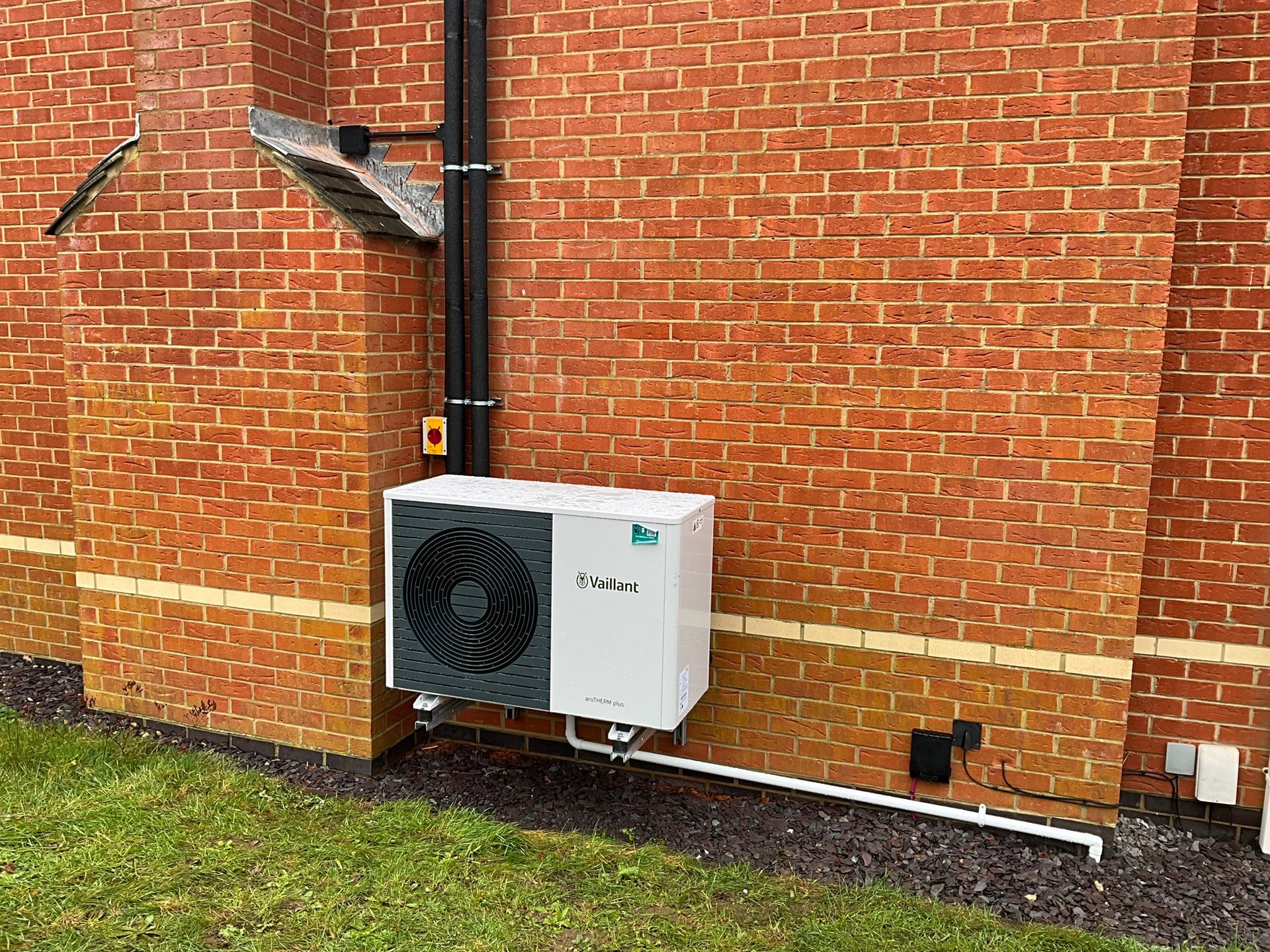
Due to its external unit, an air source heat pump is situated outside but in close proximity to your property. The typical size of an air source heat pump is approximately 1.1m x 0.45m — roughly the same as two wheelie bins placed side by side.
Ground source heat pumps require a certain amount of land and either a borehole or ground array system. Water source heat pumps require a nearby lake, river, stream, well, or borehole.
Similar to a regular boiler, heat pumps require yearly maintenance to preserve their efficiency and longevity.
The majority of heat pump installations don't require further planning permission as they fall within Permitted Development rights. You might need to apply for planning approval if you reside in a conservation area, a listed building, or if you require a larger heat pump. If we believe this will be the case for your home, we will notify you.
Financial support is provided by the UK government through the Boiler Upgrade Scheme (BUS). A grant is provided to help with the installation costs if you meet the criteria. This is something we will handle automatically on your behalf. We'll also inform you if we believe you to be ineligible and, if feasible, assist you in resolving that.
Savings Calculator
Thinking about making the switch to renewable heating? Use our heat pump returns calculator to get a clear picture of the potential savings and payback period for your home. Simply enter your property details and current heating costs to see an honest, straightforward estimate. We believe in giving you the facts so you can make the right decision for your home and budget — no pressure, just practical advice from your local heating experts in West Sussex.
Get A Quote
Still Have Questions ?
Contact Details
139 Havant Road, Hayling Island, Hampshire, PO11 0LE
Mon - Fri: 8:00am - 5:00pm
Sat: 9:00am - 1:00pm
Sun: Closed