Blog
Underfloor Heating vs Radiators — Energy, Cost & Comfort in Hampshire
Underfloor heating vs radiators: choosing the right heating for your home
As heating specialists serving West Sussex and Hampshire, we at Clean Heat Solutions often get asked about the differences between underfloor heating and traditional radiators. Both systems can deliver comfortable warmth, but they differ in how they heat a room, how they perform with low‑temperature renewables, the cost to install and run, and the practical impact on room layout. This guide compares the two on the points that matter most so you can choose the best solution for your property in Portsmouth, Southampton and across Hampshire and West Sussex.
Energy efficiency and running costs
Underfloor heating has a clear advantage for energy efficiency. Because the whole floor becomes a heating surface, it produces comfortable warmth at much lower flow temperatures than radiators, needing only a few degrees above room temperature to maintain comfort. Typical savings are in the range of 15–40% less energy compared with traditional radiators.
By contrast, conventional radiators must operate at much higher temperatures — often around 70°C — to heat a room effectively. Higher operating temperatures usually mean higher energy consumption, although modern radiators have improved efficiency compared with older models.
Heat distribution and comfort
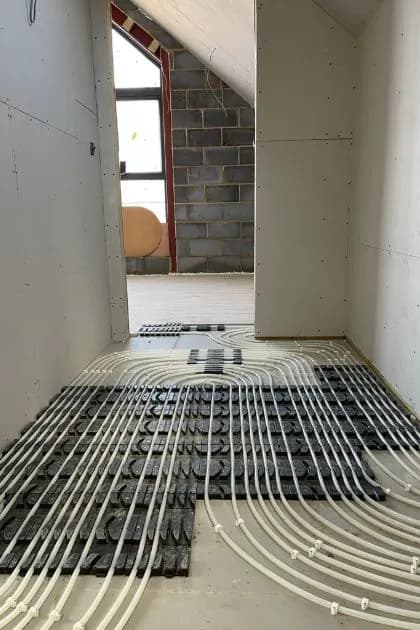
How heat is delivered is a major practical difference. Underfloor systems create even warmth from floor to ceiling, with heat rising naturally from the entire floor surface to eliminate cold spots and provide ideal temperature distribution.
Traditional radiators deliver heat from a single point on a wall, so heat tends to rise quickly to the ceiling. This often leaves warm spots near the radiators and cooler areas elsewhere in the room. Radiators still perform well, but their distribution is inherently less uniform than underfloor heating.
Installation considerations
Underfloor heating typically involves higher initial costs and a more complex installation process, which makes it particularly well‑suited to new builds or major renovations. Electric systems cause minimal disruption and work well with most floor coverings, making them a practical option for retrofit work.
Traditional radiators offer lower initial installation costs and can be fitted more quickly and easily at almost any stage of home improvement. They are also more straightforward to repair or replace individually, which can be a practical advantage in existing properties.
Compatibility with renewable heating
If you are future‑proofing your home with renewable technologies, underfloor heating shows excellent compatibility with heat pumps and other low‑temperature heat sources, working efficiently at lower temperatures.
Traditional radiators require higher temperatures to work effectively and are less efficient with heat pumps, potentially needing larger or upgraded units to work well with renewable systems. If you plan an air‑source or ground‑source heat pump installation, it is worth discussing pipework and emitter sizing with your installer. See our pages on underfloor heating services and air source heat pumps for examples of compatible systems.
Space, design and practicality
Underfloor heating offers an invisible solution that completely frees up wall space, allowing total freedom in room layout and creating a clean, minimal look throughout your home. This can be a significant benefit in smaller rooms, open‑plan layouts or where a minimal aesthetic is desired.
Traditional radiators, while available in decorative designs, inevitably take up wall space and can restrict furniture placement, impacting your room's overall aesthetics and layout options.
Response time and control
While underfloor heating takes longer to warm up initially, it provides longer‑lasting warmth with excellent heat retention, and offers the possibility of zone control for different areas.
Traditional radiators heat up quickly and respond faster to temperature changes, though the heat tends to dissipate more quickly once turned off. Both systems offer temperature control options, with radiators providing individual unit control and underfloor heating offering sophisticated zone management.
Maintenance requirements
Underfloor heating typically requires minimal maintenance and offers a longer lifespan due to fewer moving parts. However, if repairs are needed, access to embedded pipework can be more challenging.
Radiators need more regular maintenance, including bleeding and balancing, but are generally easier to access, repair or replace when problems arise.
Cost implications and property value
While underfloor heating has higher upfront installation costs, it offers lower running costs and potential energy bill savings over time. It can also add value to your property as an attractive modern feature.
Traditional radiators have lower initial costs but typically incur higher running costs and more frequent maintenance expenses, though they remain a standard and accepted property feature.
Making your choice
Choosing between these heating systems depends on factors specific to your situation. Consider your property's age and type, whether you're building new or renovating, your available budget, energy efficiency priorities, and future heating plans. Each system has its merits, and the right choice depends on your particular circumstances and requirements.
Expert advice available
At Clean Heat Solutions, we can help you make the right choice for your property. Our heating engineers are certified Heat Geek specialists, ensuring you get expert advice tailored to your needs.
For professional guidance on choosing between underfloor heating and radiators, contact us on 07391 473964 or email info@cleanheatingsolutions.co.uk, or visit our contact page. We serve all areas across West Sussex and Hampshire, including Portsmouth, Southampton, and surrounding areas.
Other Articles